You can learn tabla anywhere. You can learn it from a video, from a book of bols, from a teacher in a city apartment with the traffic outside. What Rishikesh gives you is something no syllabus contains — a place where rhythm is not entertainment but practice, where the river keeps a tempo of its own, and where the spiritual atmosphere transforms tabla from a percussion instrument into a meditation.
This is the question almost every student asks us before they arrive: why here? Why travel to a small town in the Himalayan foothills to learn a pair of drums? The honest answer has several parts — some about tradition, some about the instrument itself, and some simply about what happens to your concentration when you practise in a place built for it.
A City That Was Already Listening
Rishikesh sits where the Ganges leaves the mountains and enters the plains. For centuries it has been a place people came to in order to listen — to scripture, to a teacher, to the sound inside themselves. Long before it became known for yoga, it was a town of ashrams, of morning bells, of evening aarti drifting across the water at Triveni Ghat.
That matters more than it sounds. Tabla is not a loud instrument in its essence; it is an articulate one. It asks you to hear the difference between a ना struck at the rim and a ता struck slightly inward — a difference of millimetres and of meaning. In a noisy environment you learn to play through the noise. In Rishikesh you learn to play into the silence, and the silence tells you the truth about your stroke.
Students notice this within days. The same exercise they had been grinding through at home suddenly reveals its flaws, because for the first time they can actually hear themselves.
Rhythm is not something you impose on time. It is something you discover already moving in it. — A teaching often repeated in the guru-shishya tradition
Six Reasons Students Choose Rishikesh
Living Tradition
Tabla here is still passed hand to hand, guru to student, the way it has been for generations — not delivered as a packaged course.
An Atmosphere for Riyaz
Early mornings, clean air, the river as a drone. Daily practice stops feeling like discipline and starts feeling natural.
Music as Sadhana
You learn tabla alongside mantra, kirtan and Naad Yoga, so rhythm connects to breath and devotion, not just technique.
Musicians to Play With
Bansuri players, singers, harmonium students. Tabla is an accompanying art — here you get to actually accompany.
Built for Visitors
Teachers used to working with international students, teaching in English, without diluting the classical content.
Reachable Cost
Serious one-to-one instruction, instruments and simple accommodation cost far less here than equivalent study in the West.
Guru–Shishya: How Tabla Is Really Taught
In the Western model, a teacher gives you material and you take it away. In the guru-shishya tradition, the teacher gives you attention — and expects attention back. The relationship is longer, slower and considerably more personal.
Practically, in a Rishikesh lesson this means:
- You learn by ear before you learn by eye. Your guru recites a bol; you repeat it aloud; only then do you play it. The voice comes first because rhythm is a language before it is a physical skill.
- Correction is immediate and physical. A teacher will move your finger, adjust the angle of your wrist, tap your knee to hold the laya. No recording can do this.
- Progress is judged by sound quality, not by material covered. You may spend two weeks on a single bol until it rings clearly. This frustrates new students and then, later, becomes the thing they are most grateful for.
- Repertoire is given when you are ready for it, not according to a fixed timetable. The syllabus adapts to the student.
What surprises most beginners: the first weeks involve very little "playing music." They involve producing one clean sound, repeatedly. Tabla rewards patience at the start more than almost any other instrument — and Rishikesh is a place where patience is easier to find.
The Bols — Learning the Language First
Tabla has its own spoken vocabulary. Each stroke has a name — a bol — and compositions are recited before they are ever played. Learn the bols and you can read, remember and discuss rhythm with any tabla player in India.
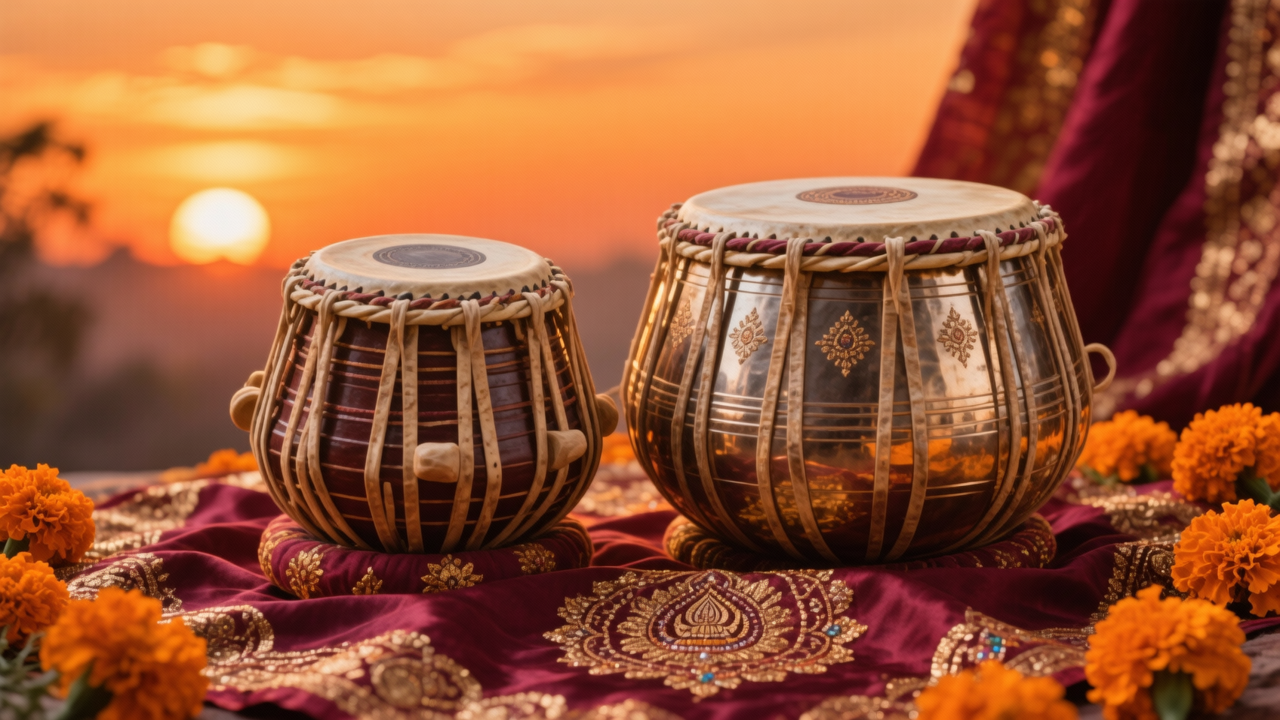
The instrument is two drums: the dayan (the smaller, wooden, tuned drum played with the right hand) and the bayan (the larger, metal, bass drum played with the left). Here are the foundational strokes you will meet in your very first sessions:
| Bol | Devanagari | Drum & Hand | How It Is Produced |
|---|---|---|---|
| Na / Ta | ना / ता | Dayan — right | Index finger strikes the rim while the ring finger rests on the black syahi. Clear, ringing, sustained. |
| Tin | तिं | Dayan — right | Index finger on the inner skin near the syahi. Higher, thinner, shorter than Na. |
| Te | ते | Dayan — right | Middle finger strikes the centre and stays down. A closed, non-resonant sound. |
| Ra | र | Dayan — right | A flick of the index finger, almost always paired as part of a faster phrase. |
| Ge / Ghe | गे / घे | Bayan — left | Middle and ring fingers strike the skin and lift, letting the bass ring open. |
| Ke / Ka | के / क | Bayan — left | Flat palm strikes and remains, damping the drum. Closed, dry, unpitched. |
| Dha | धा | Both hands | Na and Ge together — the full, round sound that opens most thekas. |
| Dhin | धिं | Both hands | Tin and Ge together. The signature sound of Teentaal. |
Notice that Dha and Dhin are not new strokes at all — they are combinations. This is the logic of the whole system: a small set of clean single sounds, combined and sequenced into endless composition. Get the singles right and everything above them is available to you. Get them wrong and no amount of speed will hide it.
Taals You Will Learn
A taal is a rhythmic cycle. Its basic pattern is the theka, and every cycle has a first beat called sam — the point of arrival — and usually a khali section where the bass drum falls silent, creating a kind of rhythmic shadow.
Teentaal, sixteen beats in four equal divisions, is where nearly every student begins:
From there the cycles open out. A typical progression at Naad Music School covers:
| Taal | Matra | Division | Where It Is Used |
|---|---|---|---|
| Teentaal | 16 | 4+4+4+4 | The universal starting point; khayal, instrumental music, most light classical. |
| Jhaptaal | 10 | 2+3+2+3 | Khayal and instrumental gats; teaches asymmetric division. |
| Ektaal | 12 | 2+2+2+2+2+2 | Slow, expansive khayal — excellent for learning to hold a long cycle. |
| Keharwa | 8 | 4+4 | Bhajan, kirtan, folk and film songs. The most immediately useful cycle. |
| Dadra | 6 | 3+3 | Light classical, thumri, devotional singing. |
| Rupak | 7 | 3+2+2 | Unusual in beginning with a khali sam — a genuine test of internal counting. |
Alongside the thekas you will learn the ornamental forms that make tabla an art rather than a timekeeping device: kaida (a theme systematically expanded and varied), rela (fast, rolling patterns), tukra and mukhda (short compositions that land decisively on sam), and eventually tihai — a phrase repeated three times so that it resolves exactly on the first beat.
A Day of Riyaz in Rishikesh
Riyaz means practice, but it carries an implication the English word lacks: daily, unbroken, unhurried. The shape of a student's day here is one of the strongest arguments for coming.
- Early morning — the best hours. Cool air, quiet ghats, mind unclouded. Slow bol practice, one stroke at a time, no metronome, listening for tone.
- Mid-morning lesson — new material with your guru: a kaida, its variations, correction of hand position.
- Afternoon — rest, or theory: notation, counting on the fingers, reciting bols aloud away from the instrument.
- Late afternoon — speed and stamina work with the lehra or a tanpura drone. This is where the hands are built.
- Evening — playing with others. Accompanying a bansuri student, joining a kirtan, or simply sitting in on someone else's lesson and listening.
Four or five hours of this, sustained across a few weeks, will move you further than a year of thirty-minute sessions squeezed between other obligations. That concentration of time is really what a stay in Rishikesh buys you.
Your Learning Journey, Stage by Stage
Weeks 1–2 · Sitting, Hands and Single Bols
Posture, how the drums are placed, how to sit for an hour without strain. Na, Ta, Tin, Te, Ge, Ke — slowly, singly, until each one rings true.
Weeks 3–6 · Teentaal and Steady Laya
The full sixteen-beat theka with hand-clap counting, khali and sam clearly felt. First simple variations. Keeping tempo without drifting.
Months 2–4 · Kaida and Composition
Your first kaida with its paltas, a tukra or two, basic tihai. You begin to understand tabla as something you can build with, not just repeat.
Months 4–8 · New Cycles and Accompaniment
Jhaptaal, Ektaal, Keharwa, Dadra. You start accompanying singers and instrumentalists — learning to listen while playing, which is a separate skill entirely.
Beyond · Speed, Gharana Colour and Solo
Rela, faster kaida variations, exposure to gharana styles, and the beginnings of a solo presentation with lehra accompaniment.
A caution about timelines. These stages are indicative, not promises. Students arrive with different rhythmic backgrounds, different hands and different amounts of practice time, and tabla is unusually honest about all three. Two students on the same schedule can be six months apart in ability. Your guru will pace you.
Choosing & Caring for Your Tabla
Rishikesh and nearby Delhi are good places to acquire an instrument, and buying with your teacher present is worth far more than buying online. A few things worth knowing:
- The dayan is tuned to a pitch, usually matching the tonic of the singer or instrument you accompany. C# and D are common general-purpose choices for students.
- Wood matters. A good dayan is turned from seasoned sheesham. Cheap, unseasoned wood cracks and never holds tune.
- The bayan should be well-weighted. Copper or good brass gives a fuller bass than thin steel and holds its tuning paste better.
- Check the syahi — the black tuning patch. It should be smooth, evenly applied and free of flaking or cracks around the edge.
- Tune with the hammer, gently. Small taps on the wooden dowels or the braided rim, working around the drum rather than forcing one point.
- Protect it from extremes. Skins react to heat and damp. Keep the drums bagged, out of direct sun, and never leave them near a heater.
Expect to spend meaningfully more on a serviceable student set than on a decorative one. A tourist-market tabla that will not hold pitch is not a saving; it is an obstacle to learning.
Who This Is For
Tabla study in Rishikesh suits a wide range of people, and it is worth being clear about who tends to thrive:
- Complete beginners with no musical background at all. Tabla starts from the voice and the hand, not from written music.
- Drummers and percussionists from other traditions, who usually find the technique humbling and the rhythmic mathematics fascinating.
- Yoga teachers and practitioners wanting rhythm for kirtan, chanting and sound work.
- Singers and instrumentalists who want to understand taal from the inside so they can work better with accompanists.
- Returning students who learned some tabla years ago and want a period of focused correction.
It suits you less well if you are looking for a quick, impressive result in a week. Tabla will give you a lifelong practice, but it does not give away much in the first few days.
Practical Notes Before You Come
- Season. October to March is pleasant and dry. April to June is hot but workable in the early morning. July to September brings the monsoon — green, dramatic, humid, and hard on drum skins.
- Getting here. Fly to Dehradun (Jolly Grant), roughly forty-five minutes away, or take the train or bus from Delhi and Haridwar.
- How long to stay. Two weeks gives you a genuine foundation. A month or more is where real change happens.
- Nails short, always. Long fingernails make clean tabla strokes impossible.
- Bring a notebook. Write bols down after each lesson, in your own hand. It is how the material sticks.
- You need not own an instrument to begin. Practice drums are available at the school while you decide what to buy.
- Rishikesh is a vegetarian, alcohol-free town by custom and by law in the ashram areas. Most students find this suits the discipline of study.
- If you cannot travel, the same teachers work online. It is not identical to sitting in the room, but with a good camera angle and a decent microphone it is genuinely effective.
Questions Students Ask
Do I need any musical experience to start tabla?
No. Most of our tabla students begin with none. The first weeks are about producing clean single sounds and reciting bols aloud — neither requires prior training, and neither requires reading music.
How long before I can play something recognisable?
Most students can play the Teentaal theka at a slow, steady tempo within two to three weeks of daily practice, and can hold Keharwa well enough to accompany simple bhajan singing not long after. Playing it well — with clear tone and unwavering laya — takes considerably longer, and that gap is the whole substance of tabla study.
Will my hands hurt?
Some tenderness in the fingertips is normal in the first weeks and passes as the skin adapts. Sharp pain in the wrist or forearm is not normal — it usually signals a technique fault, and you should stop and tell your teacher rather than push through it. Correct tabla technique is relaxed; strain is a sign that something is wrong.
Is tabla harder than Western drums?
Different rather than harder. A drum kit distributes rhythm across four limbs; tabla concentrates it into ten fingers producing many distinct named sounds, each of which must be individually clean. Drummers usually find the rhythmic concepts comfortable and the tone production much harder than they expected.
Can I learn tabla and another instrument at the same time?
Yes, and many students combine tabla with vocal training or bansuri. Learning to sing even a little makes you a far more sensitive accompanist. Discuss the balance with your teachers so your practice time is divided sensibly.
What does a tabla cost?
Prices vary with wood quality, the metal of the bayan and the maker, so we would rather not quote a figure that goes stale. Come to the shop with your teacher — the guidance on what to avoid is worth more than the price comparison, and you will pay a fair local rate.
Do you teach children?
Yes, with shorter sessions and lighter practice loads. Children often pick up bol recitation remarkably quickly. Please contact us so we can match the child to the right teacher and schedule.
Come and Sit at the Drums
Whether you have three weeks in Rishikesh or three months, whether you have played all your life or never touched a drum, there is a place for you at Naad Music School.
Book a Class Tabla Course Details Ask a Question